Breeding season for Pteromys volans orii

Breeding season has arrived for the Pteromys volans orii.
The past few years, we have been fortunate enough to see them during this season. Ordinarily,
Pteromys volans orii come out of their nests at sunrise and sunset. However, during the breeding season, they come out between 2:00 p.m. and 4:00 p.m.
At the time of this sighting, they had already left their nests at around 2:00 p.m. and seemed to be chasing each other around.
A few minutes after approaching each other, they began mating.
However, their darting around in the forest had attracted several crows that stood nearby.
Because I was watching from a short distance away, the crows did not approach the squirrels. I felt relief when the squirrels concluded their mating without incident.
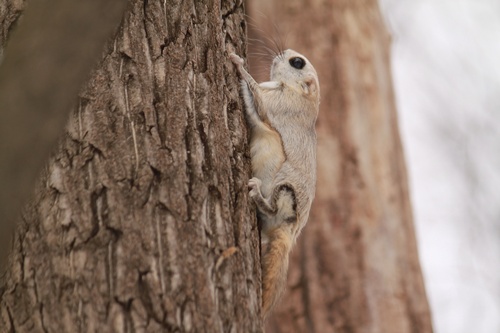
Photos: Mating Pteromys volans orii Mar. 19
There’s something inside…

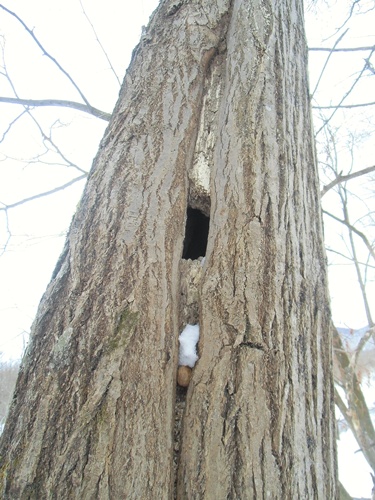
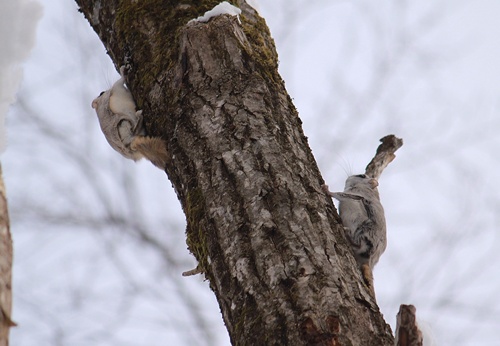
There’s something inside the space in this Populus suaveolens.
A walnut seems to have been placed below the hole intentionally.
I’ve often heard that Dendrocopos major prepare their meals in advance. But perhaps this is the work of Sciurus vulgaris orientis or crow.
Crows are thought to eat on the spot, so maybe the walnut was hidden there by the Sciurus vulgaris orientis.
But what lives in the hole?
Sciurus vulgaris orientis? Martes zibellina brachyura? Strix uralensis coreensis?
One of the fun things about a nature walk is discovering mysteries like this in the forest and then letting your imagination run wild as you try to explain them.
Photo: The work of Sciurus vulgaris orientis? Mar. 17

Turdus naumanni naumanni and Carduelis flammea

This may be a great year to see Carduelis flammea.
In some years they never even arrive in Sounkyo, but this year they are here in considerable numbers.
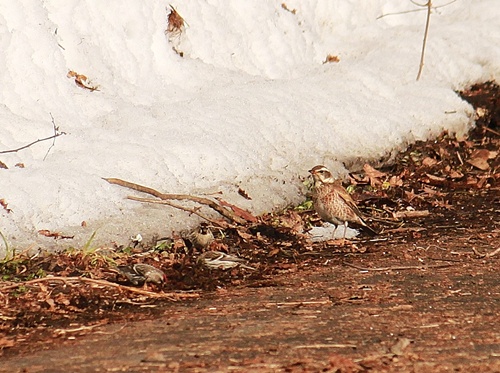
Yesterday I heard Carduelis flammea calling during a walk; their call sounds something like “chu-een.” When my eyes went in that direction, I saw that the birds were feeding together with what looked to be Emberiza cioides.
I looked more closely and noticed that they are much larger than the Emberiza cioides. I approached quietly and heard a call that, though infrequent, sounded like that of Turdus eunomus.
When I moved even closer, I saw that the birds were Turdus naumanni naumanni, a species that only rarely comes to Japan.
Ordinary Turdus eunomus have a black band on their breast; however, Naumann’s thrushes have a reddish brown color. The birds in the photograph have a slightly red coloring. There is considerable variation among individuals, with some having an intermediate coloring among Turdus eunomus. They are playfully referred to as “six-mat thrushes,” “four-and-a-half-mat thrushes,” etc., (referring to tatami mats) depending on their coloring. (It appears that their Japanese name tsugumi came from their initial discovery on Hachijojima Island; however, there are also claims that their first recorded sighting in Japan was in Hakodate.)
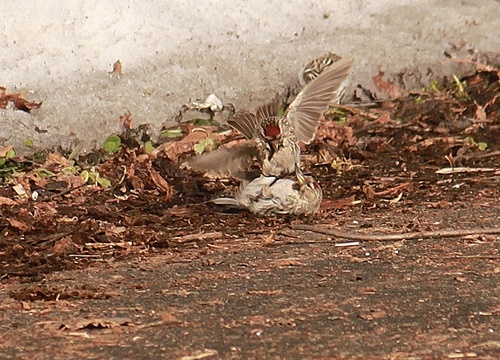
Just then, “one-on-one combat” broke out among some of the Carduelis flammea.
Or so I thought. Actually, they had begun mating.
The whole encounter was over in a moment, but it was an indicator that spring has arrived for the birds.
Photos: Turdus naumanni naumanni (left) and Carduelis flammea (right) Mar. 17

A Visitor Center course

The daytime temperature outside the center today reached +2°C. It was the first time since February 27 that the temperature climbed above 0°C.
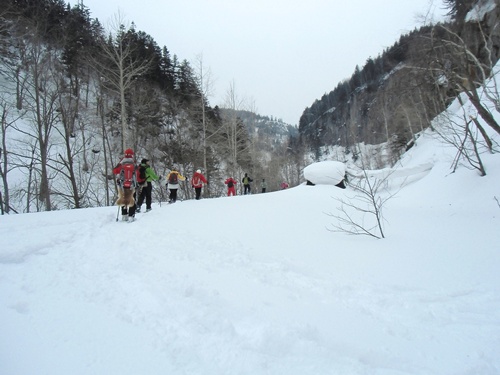
Amid the higher temperatures, the Visitor Center held a course on “Obako and Hakonoue.” A total 15 people participated. (Originally, the course was scheduled to study Tokachi Mitsumata, however the plan was changed due to concerns about the snow there.)
Obako is a popular sightseeing spot in Sounkyo. The course featured a snowshoe walk to the upper area of Obako.
The name Hakonoue is often used to refer to all of the cliffs of columnar jointing near Obako.
However, originally, it was noted as a third-order triangulation point on a line linking the first-order triangulation points of Mt. Asahi and Mt. Murii.
Entering the stream valley, one can see that both banks are formed by columnar jointing. The towering rocks create quite an imposing scene.
The columns (made of Sounkyo welded tuff) were formed about 30,000 years ago when volcanic ejecta from Ohachidaira became a pyroclastic flow that buried low-lying areas and valleys and then, later, hot deposits there cooled and hardened.
The area is covered by coniferous trees (with some birch). One can imagine that it took a very long time for these trees to become established.
There is little soil in the area, and thus those trees that cannot extend their roots down deeply are prone to toppling. In particular, many trees that were knocked down by the snow, rock collapses, rain, and other causes could be seen in the stream valley.
Photo: Course participants walking in upper Obako Mar. 16

A forecast for snow again from tomorrow

Like yesterday, it has been a fine day at Sounkyo.
Unfortunately, the weekly weather forecast predicts nothing but snow again.
The morning started out clear and sunny, but the clouds have gradually increased through the day.
Nonetheless, the views of Mt. Kurodake and neighboring mountains are fantastic.
The snowfall has been plentiful. As of today, there are 420 cm of accumulated snow at the 7th Station. Last year, the 400-cm mark was not reached until the end of March, so the snowfall is slightly greater this year than last year.
Early this morning, the Betula ermanii and other trees were covered with snow near the 1,300-meter level. The result was a very dream-like landscape.
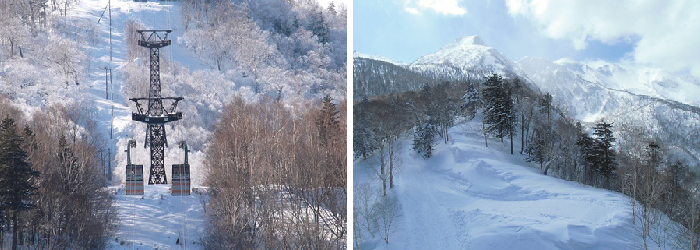
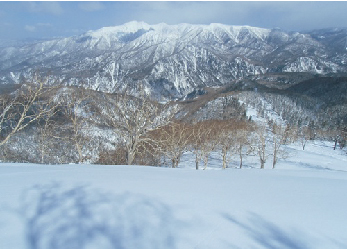
Photos: Moving into the snow-covered landscape (left); the view of the Daisetsuzan peaks from the 5th Station observatory (center); and the view of Mt. Niseikaushuppe from near the 7th Stationclimbing office Mar. 12